RTRL.03: “Audiation-based Improvisation Techniques and Elementary Instrumental Students’ Music Achievement” (Azzara, 1993)

Source:

Azzara, C. D. (1993). Audiation-based improvisation techniques and elementary instrumental students’ music achievement. Journal of Research in Music Education, 41(4), 328-342.

What did the researcher want to know?

What effect does an improvisation curriculum have on instrumental students’ music achievement?

What did the researcher do?

Azzara (1993) studied 66 fifth grade students from two different schools who were in their second year of instrumental music study.  Students at each school were randomly assigned to either the control group or the treatment group.  Both groups received instruction using Jump Right In: The Instrumental Music Series, which utilizes a “sound before sight” learning process and includes tonal pattern and rhythm pattern instruction.  In addition, the treatment group also regularly engaged in improvisation activities, which included “(a) learning selected repertoire of songs by ear, (b) developing a vocabulary of tonal syllables and rhythm syllables, and (c) improvising with their voices and with their instruments tonic, dominant, and subdominant tonal patterns within the context of major tonality, and (d) improvising with their voices and with their instruments macrobeat, microbeat, division, elongation, and rest rhythm patterns within the context of duple meter” (p. 335).

What did the researcher find?

At the end of the 27-week period, Azzara (1993) recorded each student individually performing three etudes: one prepared without teacher assistance, one prepared with teacher assistance, and one sight-read.  Four judges rated each recording for tonal performance, rhythm performance, and expressive performance.  Statistical analysis of these ratings revealed that the students in the treatment group (who had experienced improvisation activities) had significantly higher composite etude performance scores than students who had not received instruction incorporating improvisation.

What does this mean for my classroom?

Having experiences with improvisation can help improve students’ performance achievement.  Just as speaking and conversing enhance the skills of reading and writing language, improvising music can enhance students’ music reading skills and performance of notated music. “When improvisation was included as a part of elementary instrumental music instruction, students were provided with opportunities to develop an increased understanding of harmonic progression through the mental practice and physical performance of tonal and rhythm patterns with purpose and meaning. Improvisation ability appears to transfer to a student’s clearer comprehension of the tonal, rhythmic, and expressive elements of music in an instrumental performance from notation” (p. 339).

Suggestions for Teaching Improvisation:

(From Azzara’s 1999 MEJ article “An Aural Approach to Improvisation”)

  • First and foremost, “use your ears. To develop improvisational skill, don’t rely on notation to remember music; rely on your ears” (p. 23).
  • Provide students with opportunities to listen to music (e.g., performed by the teacher, recorded music) in a wide variety of styles, tonalities (i.e., modes), and meters.
  • Develop a repertoire of simple tunes that students can sing and play by ear.
  • Teach students to sing and play basslines of simple tunes by ear.
  • Chant simple rhythm patterns for students to echo (chant/play) to develop their rhythmic “vocabulary” and sing simple tonal patterns for students to echo (sing/play) to develop their tonal “vocabulary.”

Examples of Rhythm Patterns and Tonal Patterns:

  • Learn tonal solfege and rhythm syllables by ear. These systems help students organize, comprehend, and read/write music.
  • “Improvise (1) rhythm patterns with and without rhythm syllables, (2) tonal patterns with and without tonal syllables, (3) rhythm patterns to familiar bass lines, and (4) rhythms on specific harmonic tones from particular harmonic progressions [e.g., to familiar tunes]. Improvise a melody by choosing notes that outline the harmonic functions of the progression (i.e., notes chosen from arpeggios) and perform them on each beat” (p. 23).
  • Play around with embellishing melodies, harmony parts, chord tones, and basslines.

Azzara’s 2011 TEDx Talk on Improvisation

Other Helpful Resources:

Developing Musicianship Through Improvisation

Jump Right In: The Instrumental Series

RTRL.02: “Elementary Students’ Definitions and Self-Perceptions of Being a ‘Good Musician’” (Shouldice, 2014)

Source:

Shouldice, H. N. (2014). Elementary students’ definitions and self-perceptions of being a ‘good musician.’ Music Education Research, 16(3), 330-345.

What did the researcher want to know?

What do elementary students believe it means to be a “good musician” and to what extent do they perceive themselves to be “good musicians?” 

What did the researcher do?

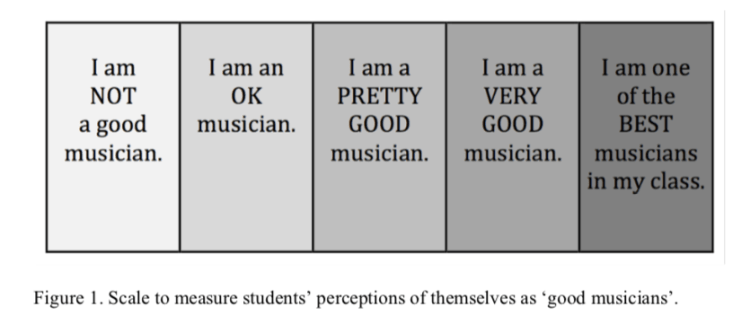
Shouldice (2014) individually interviewed 347 students in grades one through four.  The students answered questions pertaining to the kinds of things a good musician can do, how one knows if a person is a good musician, and who can be a good musician. At the conclusion of each interview, each student was asked to choose the statement that best described him/herself (see scale in Figure 1) and explain why.

What did the researcher find?

While students across all grade levels most commonly described a “good musician” as someone who plays an instrument, practices, and/or sings well, other characteristics fluctuated across grade levels, suggesting that students’ perceptions of what it means to be a “good musician” may change over time in relation to their own experiences.  Statistical analysis showed that students in grade one perceived themselves as better musicians than did students in upper grade levels, indicating that elementary students’ perceptions of their own musical ability may diminish as they get older.

Qualitative analysis of the data revealed that some children’s ability self-perceptions were based on how they believed others perceived their abilities, such as a first-grade girl who knew she was a good musician “because my [music] teacher always picks me first” (p. 336), or were reached as a result of comparing themselves to others.  A number of students believed that innate musical talent is necessary in order for a person to be a “good musician;” their comments included the belief that “only some people are born with the talent” and “either you got it or you don’t” (p. 339).  Additionally, responses from some students implied the belief that skill in certain musical genres or modes of music making do not qualify one as a “good musician,” such as one second-grade boy’s statement that rappers and beat-boxers cannot be good musicians and that he himself was not a good musician despite describing himself as a “rapping pro.”

What does this mean for my classroom?

Elementary music teachers should be aware of the tendency for students’ musical ability self-perceptions to diminish over time and work to help students maintain positive musical identities as they get older.  Teachers also should be aware of the ways in which they might inadvertently communicate their own judgments of students’ musical abilities and/or beliefs about the value of certain musical genres or modes of musicking.  Additionally, teachers can encourage students to focus on effort and practice as determinants of musical ability rather than emphasizing innate musical talent.  

Note: Text featured in this post was originally published in the following article:

Shouldice, H. N. (2016). Research to ‘real life’: Implications of recent research for elementary general music. Michigan Music Educator, 53(2), 23-26.

RTRL.01:“The Effects of Harmonic Accompaniment on the Tonal Improvisations of Students in First Through Sixth Grade” (Guilbault, 2009)

Source:

Guilbault, D. M. (2009). The effects of harmonic accompaniment on the tonal improvisations of students in first through sixth grade. Journal of Research in Music Education, 57(2), 81-91.

What did the researcher want to know?

How might experiencing root melody (bassline) accompaniment to songs affect elementary students’ tonal improvisations?

What did the researcher do?

Guilbault (2009) studied 419 of her own students in grades one through six for almost an entire school year.  These students were divided into two groups, with approximately half of the classes (the “treatment” group) experiencing “root melody” accompaniments during music instruction and the other half (the “control” group) experiencing only a cappella singing.  Similar to a bassline, “a root melody is the melodic line created by the fundamental pitches of the harmonic functions found in a song” (p. 84).  Pitches in a root melody can be played/sung and sustained once per chord change or repeated on each beat.  The students in the treatment group experienced root melodies with approximately 80% of the songs included in each class period and during improvisation activities.  These root melody accompaniments were either played on a pitched instrument (e.g., xylophone, piano), played by a voice recording, sung by the teacher/researcher as the students sang a song, sung by the students as the teacher/researcher sang a song, or sung by the student(s) as another student(s) sang a song.  The students in the control group experienced all the same songs and improvisation activities as the treatment group but without any accompaniment.

What did the researcher find?

At the end of the school year, Guilbault (2009) recorded each student vocally improvising an ending to an unfamiliar song without accompaniment. Three music educators judged the recordings, rating the degree to which each student improvised a melodic ending that used clearly implied harmonic changes and good harmonic rhythm. Statistical analysis of these ratings revealed that the students in the treatment group (who had experienced root melody accompaniments throughout the school year) were able to vocally improvise song endings that made more harmonic sense than students in the control group (who had not experienced root melody accompaniments).

What does this mean for my classroom?

Exposing students to harmonic progressions in familiar songs helps them develop better harmonic understanding, which in turn enables students to vocally improvise with a better sense of harmonic progression. If music teachers wish to help their students develop the ability to vocally improvise with a good sense of harmonic progression, they might consider providing students with many opportunities to experience root melody accompaniments to the songs they learn in music class. Teachers could do this by playing root melody accompaniments on an instrument, singing them while students sing a song, teaching students to sing root melody accompaniments while the teacher sings the song, or having students sing songs and root melody accompaniments in two groups or even as duets.

Examples of Tunes with Simple Chord Root Accompaniments:

Video of first grade students practicing singing a melody and bassline/chord root accompaniment in partners. (View video description on YouTube site for an overview of the teaching process used.)
Video of first grade students singing a duet with me: I sing melody; student sings chord roots in solo. (View video description on YouTube site for an overview of the teaching process used.)

Note: Some text featured in this post was originally published in the following article:

Shouldice, H. N. (2016). Research to ‘real life’: Implications of recent research for elementary general music. Michigan Music Educator, 53(2), 23-26.

Why “Research to Real Life”?

That research stuff only matters in the “ivory tower” and has nothing to do with real music teachers, right? Wrong! This blog will share findings of recent research studies that are relevant for music educators and can inform our teaching practice. Instead of focusing on jargon and statistics, we will look at how these research findings can be applied in practical ways to improve the experiences we provide our students.

“Rather than assuming we know what is effective or doing something because ‘that’s how we’ve always done it,’ music teachers can advance their teaching practice in an evidence-based way by reading current music education research” (Shouldice, 2016, p. 25).


Shouldice, H. N. (2016). Research to ‘real life’: Implications of recent research for elementary general music. Michigan Music Educator, 53(2), 23-26.