RTRL.09: “Career Intentions and Experiences of Pre- and In-Service Female Band Teachers” (Fischer-Croneis, 2016)

Source:

Fischer-Croneis, S. H. (2016). Career intentions and experiences of pre- and in-service female band teachers. Journal of Research in Music Education, 64(2), 179-201.

What did the researcher want to know?

What are women’s experiences in realizing their professional goals as band teachers?

What did the researcher do?

Fischer-Croneis conducted a multiple case study of nine women in the midwestern U.S. who were teaching band or finishing their undergraduate preparation to become band teachers. The inservice teachers’ years of experience ranged from 4 to 34, and they were teaching either middle school or a combination of middle and high school. Fischer-Croneis individually interviewed each participant, using open-ended questions to elicit discussion regarding their experiences as female band teachers in two main areas of focus: 1) Gaining entry into the profession, and 2) Navigating the profession.

What did the researcher find?

In terms of gaining entry into the band-teaching profession, several participants described experiences in which they had been given interview-related advice based on their gender, were asked interview questions they felt a man would not have been asked, or believed they had not been offered high school band teaching jobs due to their gender. Others sensed “the potential for unspoken bias,” including one young woman who felt that a hiring committee might question whether she would “do this job to the full extent” due to the assumption that “she’s in a prime baby-making age” (p. 187).

In navigating the profession, some of the participants felt pressure to adopt a more “masculine professional persona” in order to be accepted in the “band world” (p. 188). While they did feel that it was becoming easier to identify female band teachers at the national level, such as Mallory Thompson at Northwestern University, many participants were unable to name a female band teacher they knew at the local level. Only one of the three preservice teachers was able to name a female high school band teacher.

Though they felt things were improving, all of the in-service teachers confirmed the perception of a “Good Ol’ Boys’ Club” in the band world, which they most notably felt at places like state conferences or the Midwest Clinic. Other experiences shared by participants included being mistaken for the assistant band director (because the male assistant was assumed to be the head director), challenges in networking “with those in power—perceived by many of the participants to be typically men,” and a feeling of a “double standard” in that “the assertive behavior [a woman] must embody to be a successful band teacher [does] not match social conventions for women” (p. 192).

What does this mean for my classroom?

Women continue to be a minority in the band teaching profession, and many female teachers experience persistent feelings of exclusion in the band world. Female band teachers in a similar study by Coen-Mishlan (2015) even felt they were treated differently at adjudicated events and questioned whether their bands were judged more critically. Music teachers and music teacher educators should remain aware of the underrepresentation of women in the band teaching profession and the resultant lack of role models for female band teachers. We can look for instances in which gender stereotypes may be reinforced. For example, an examination of the photographs featured in issues of Music Educators Journal from the years 1962-2011 revealed that 79% of the photographs depicting conductors showed men in this role, and there were no photographs of female conductors in any issue of MEJ during 2001 (Kruse, Giebelhausen, Shouldice, & Ramsey, 2015). Media that music teachers use in their classrooms may also reinforce similar stereotypes, which we can look for and avoid. 

In addition to avoiding the perpetuation of gender stereotypes, we can actively work to combat them by exposing students to examples and images of female band directors. Individuals serving on hiring committees should be conscious of the possibility of bias against female band teachers, particularly when filling high school band teaching positions, and male band teachers can consciously work to help women feel included and valued in the profession.

References:

  • Coen-Mishlan, K. (2015). Gender discrimination in the band world: A case study of three female band directors. Excellence in Performing Arts Research, 2, Article 1. https://doi.org/10.21038/epar.2014.0104
  • Kruse, A. J., Giebelhausen, R., Shouldice, H. N., & Ramsey, A. L. (2015). Male and female photographic representation in 50 years of Music Educators Journal. Journal of Research in Music Education, 62(4), 485-500. https://doi.org/10.1177/ 0022429414555910

RTRL.08: “An Examination of Music Teacher Job Interview Questions” (Juchniewicz, 2016)

Source:

Juchniewicz, J. (2016). An examination of music teacher job interview questions. Journal of Music Teacher Education, 26(1), 56-58.

What did the researcher want to know?

What do principals think are the most important questions to ask when interviewing prospective music teachers? Does a principal’s school level, setting, or years of experience affect which interview questions they believe are more important?

What did the researcher do?

Juchniewicz surveyed 405 principals in North Carolina via an online questionnaire. Respondents were asked to rate the importance of 27 given interview questions and were provided an opportunity to list any additional questions they believed were important.

What did the researcher find?

The top three interview questions rated as most important by principals overall were:

  • “How will you connect with your students?”
  • “Tell me what I’ll see happening in your classroom.”
  • “How would you make sure students are successful in music?” 

This table shows the rankings and mean ratings of the top 20 most important interview questions (p. 62):


Principals rated each question on a 5-point scale
(1 = “not important at all” to 5 = “very important”).

Perceived importance of questions did not vary significantly by principals’ school level (elementary, middle school, or high school), setting (urban, suburban, or rural), or years of experience (5 or more years or less than 5 years). Among the free responses provided, “integrating other subjects into the music classroom” and “team player/colleague” emerged as common themes.

What does this mean for my classroom?

Regardless of whether you are applying for a music teaching job in an elementary, middle, or high school or in an urban, suburban, or rural area, certain questions are likely to be asked in the interview.  “Music teacher candidates should pay particular attention and be prepared to respond to several of the interview questions … rated as very important by principals of the present study” (Juchniewicz, 2016, p. 66).

RTRL.07: “Teachers’ Beliefs Regarding Composition in Elementary General Music” (Shouldice, 2014)

Source:

Shouldice, H. N. (2014). Teachers’ beliefs regarding composition in elementary general music: Definitions, values, and impediments. Research Studies in Music Education, 36(2), 215-230.

What did the researcher want to know?

How do elementary music teachers define composition, what relationships exist between their beliefs about the importance of composition and their use of composition, why do they believe composing is valuable, and what prevents them from incorporating more composition in their classrooms?

What did the researcher do?

Shouldice surveyed 176 elementary general music teachers from across Michigan via an online questionnaire, which included items such as the following:

  • Please describe the characteristics of music composition. (e.g., What is composition? What does it entail?) 
  • Why do you feel composition is or isn’t important for elementary music students? 
  • What influences your decision to NOT incorporate composition in elementary general music? (OR what influences you to not incorporate composition more frequently?) 

What did the researcher find?

Definitions of Composition:

Many teachers agreed that composition involves creating, self-expression, and replication.  However, they differed in their beliefs about the complexity of composition and/or whether it requires notation.  While some teachers believed that composition involves the creation of a complete piece of music, others believed it could be as simple as creating a melody or an ostinato pattern.  Similarly, while some believed that composition by nature involves the notating of musical ideas, others believed it could be strictly aural/by ear.

Use and Importance/Value of Composition:

Teachers’ use of composition increased with grade level.


There was a positive correlation between teachers’ beliefs about the importance of composition and their use of composition.  Teachers who believed composition was more important were more likely to include it in their teaching and to do so more frequently than teachers who believed composition was less important.  Many teachers expressed beliefs that composition is valuable because it helps students develop, demonstrate, and apply their understanding of musical concepts and skills; develops creativity; allows self-expression; and lets students take ownership of their music-making.

Impediments to Composition:

When asked what keeps them from doing more composing with their students, many teachers mentioned time (amount of contact time with students and/or feeling that composition takes too long).  Another common struggle cited was logistics, including large class sizes and a lack of resources (e.g., instruments, technology).

What does this mean for my classroom?

Elementary music teachers who don’t believe composition is important may be less likely to provide their students with composing experiences.  Therefore, helping teachers see the value of composing may increase the likelihood they will teach it!  Click below to view a presentation slide deck for this study, which includes direct quotes from teachers who participated about why they believe composition is important:

Teachers’ conceptions of composition likely influence whether, when, and/or how they teach it.  Given that more teachers in this study incorporated composing into later grade levels than early grade levels, it might be because many believe composition must be complex and/or notated, whereas teachers who incorporate composing in early grade levels may be more likely to do so in simple, aural/ear-based ways.

Broadening teachers’ conceptions of composition may help alleviate perceived impediments.  How might elementary music teachers incorporate composing in ways that are simple, quick, don’t involve notation, and don’t require instruments/technology? 

Ideas for Aural Composition:

Composing a Melody for a Familiar Chant:
  1. Review a familiar chant, such as “Engine, Engine” while moving to big/little beats.
  2. Choose and establish tonality and sing several tonal patterns for the class to echo. Then invite students to improvise a tonal pattern that is different from yours. Repeat several times to “get the musical juices flowing.”
  3. Invite students to improvise tonal patterns to use in the song, practicing each phrase as it is created. (Tip: I find it helpful to notate/dictate students’ ideas on the board as they create them so that I can help them retain/replicate their melody.)
Sample class melody for the chant “Engine, Engine”
Composing a Melody for a Poem:
  1. Choose a simple poem (like “The Mule” below). Have the class try chanting the chosen poem in duple meter while moving to big/little beats. Then try chanting the poem in triple meter while moving to big/little beats. Invite the class to vote to choose meter.
  2. After deciding the meter, try chanting the poem while teacher accompanies with I/V chords in major tonality. Then try chanting while teacher accompanies with I/V chords in minor tonality. Invite the class to vote to choose tonality.
  3. Optional: Sing a few tonic/dominant tonal patterns in the chosen tonality for the class to echo. Then ask the class to sing back a few patterns that are different from yours. (I find that this step helps prepare the students to improvise melodically in the next step.)
  4. Invite the class to try improvising pitches for “Voice of the mule” as a group. Invite an individual student to share their idea, and have the class echo. Have class sing again and then add on a group improvisation for “bray.” Invite another individual student to share an idea, and have the class try echoing. Continue adding on new improvisations until you have an entire composed melody! (Tip: I find it helpful to notate/dictate students’ ideas on the board as they create them so that I can help them retain/replicate their melody.)

SAMPLE POEM:

“The Mule” by Douglas Florian

Voice of the mule: bray.

Hue of the mule: bay.

Fuel of the mule: hay.

Rule of the mule: stay.

Melody for “The Mule” composed by one 3rd grade class
Another version of “The Mule” composed by a second 3rd grade class

Shout-out to Jennifer Bailey, music teacher in the Farmington (MI) Public Schools, for this idea! Visit Jennifer’s website (www.singtokids.com) for more great teaching ideas.

Any children’s poem can work for this composition project, but Jennifer shared with me the poems of Douglas Florian, featured in books such as Beast Feast, Mammalabilia (which includes “The Mule”), and Insectlopedia.  After composing a few as a class, I would then let the students work in small groups to choose a poem and create a melody for it using the same process. I would give the students this checklist I created as a guide:

Once each group decided on their poem, I highlighted the text using two colors to indicate a harmonic progression. One color represented tonic and the other represented dominant. The groups would use the color-coding to play chords (on a Q-chord, iPad in Garage Band, etc.) when choosing their tonality and composing their melody. Here is an example of a color-coded poem:

Because this project took several days to complete, the groups would record their progress with an audio-recording device (e.g., small digital audio recorder, voice memos, etc.) at the end of each class and then listen to their recording at the beginning of the next class to get their melodies back in their heads. When the groups were done, they recorded a final version of their melody, which I uploaded to our music program website and also burned onto CDs for each student, titling the album “John Doe Elementary School’s Carnival of the Animals.” Here is a video of one group practicing their composition:

Third grade students working on their small group composition

Here is their finished audio recording:

Here is another group’s version of the same poem (Douglas Florian’s “The Tiger”):

Poem (“The Tiger”) by Douglas Florian, Melody by 3rd grade students

And here is one more final version of another poem (Douglas Florian’s “The Whale”):

Poem (“The Whale”) by Douglas Florian, Melody by 3rd grade students
Other Simple Composing Ideas?
  • Have students create a four-beat rhythm (chant on “bah” or play on an unpitched percussion instrument) to perform as a rhythmic ostinato to accompany a song/chant. (For more challenge/extension, have students add rhythm syllables to their ostinato and/or notate it.)
  • Combine a created rhythm with the bassline/chord roots to a familiar song to create a harmonic accompaniment. (For more on basslines/chord roots and teaching them, see this post.)
  • Create a variation of a familiar song by improvising a new tonal pattern to replace a repeated pattern in a song.

For many more ideas as well as how to help better prepare your elementary students for composing, see my book chapter:

Shouldice, H. N. (2018). Audiation-based improvisation and composition in elementary general music. In S. Burton & A. Reynolds (Eds.), Engaging musical practices: A sourcebook for elementary general music (pp. 113-134). Lanham, MD: Rowman & Littlefield.

RTRL.06: “Investigating Adjudicator Bias in Concert Band Evaluations” (Springer & Bradley, 2018)

Source:

Springer, D. G., & Bradley, K. D. (2018). Investigating adjudicator bias in concert band evaluations: An applications of the Many-Facets Rasch Model. Musicae Scientiae, 22(3), 377-393.

What did the researchers want to know?

What is the potential influence of adjudicators on performance ratings at a live large ensemble festival?

What did the researchers do?

Springer and Bradley (2018) collected evaluation forms from a concert band festival in the Pacific Northwest U.S. Each of the 31 middle school/junior high school bands performed three pieces and were rated by three expert judges on a scale of 5 (superior) to 1 (poor). Judges were also allowed to award “half points,” and they rated each group on eight criteria: tone quality, intonation, rhythm, balance/blend, technique, interpretation/musicianship, articulation, an “other performance factors” (such as appearance, posture, and general conduct). The researchers analyzed the data through a complex process called the Many-Facets Rasch Model.

What did the researchers find?

The use of half-points resulted in less clear/precise measurement than if half-points had not been allowed. All but one of the performance criteria “did not effectively distinguish among the highest-performing ensembles or the lowest-performing ensembles” (p. 385), which could indicate a halo effect–when judgements of certain criteria positively or negatively influence judgements of other criteria. Examination of judge severity revealed that one judge was more severe in their ratings than the other two, though all three more heavily utilized the higher end of the rating scale, indicating “leniency or generosity error” (p. 386). Finally, numerous instances in which some bands were rated unexpectedly higher or lower by one judge than the other two suggests “evidence of bias” (p. 386).

What does this mean for my classroom?

Adjudication training and calibration—ensuring judges rate in similar manners—is critical. Adjudicator training for the band festival studied by Springer and Bradley involved only a 30-minute session in which the adjudicator instructions and evaluation form were discussed and adjudicators were allowed to ask questions. A more in-depth and ongoing adjudicator training process may help improve the validity and reliability of ratings given. For example, Springer and Bradley suggest that adjudicators might participate in an “anchoring technique”—a process in which judges rate sample recordings and then discuss the specific “aural qualities necessary for rating each performance criterion on the scales provided on the evaluation form” (p. 389).  Festival coordinators might also attempt to hire adjudicators from other geographic regions in order to reduce bias due to prior familiarity with bands or directors.

RTRL.05: “Voice Change and Singing Experiences of Adolescent Females” (Sweet, 2018)

Source:

Sweet, B. (2018). Voice change and singing experiences of adolescent females. Journal of Research in Music Education, 66(2), 133-149.

What did the researcher want to know?

How does the adolescent female voice change influence young women’s use of their voice and their participation in singing in middle school, high school, and/or college?

What did the researcher do?

Sweet (2018) studied 17 female collegiate choral singers through one-on-one and focus group interviews.  She prompted the young women to reflect on their singing experiences since age 11, vocal challenges they have faced, and perceptions of how others interacted with them during their voice change experiences.

What did the researcher find?

Participants recalled experiencing numerous vocal challenges during adolescence, including vocal cracks, breaks, weakness, and unpredictability.  Additional challenges, such as laryngeal tension and lack of vocal flexibility, continued throughout adolescence.  Some participants noted that these changes extended into their 20s.

Participants’ recollections of their singing experiences since age 11 were more negative than positive. Emotions like frustration, fear, sadness, self-doubt, insecurity, and self-deprecation were prominent in their memories of singing during voice changes.  Sweet keenly noted that, as conveyed via participants’ tone of voice, facial expressions, and word emphasis, vocal challenges during adolescence were highly emotional experiences.

Teachers’ classification of adolescent female voices was a notable theme among the singers’ experiences.  “Participants who experienced a loss of strength or color in their higher range and had a stronger lower range mostly sang alto lines; participants who experienced a lack of phonation or lost power in lower notes were mostly assigned to higher vocal lines” (p. 142).  Rather than working with these singers through their difficulties, they felt their teachers had assigned them voice parts based on what was needed for the choir as a whole, at times even assigning them to sing vocal parts that were physically uncomfortable.  Additionally, “many participants felt that being assigned a particular voice part in middle school or early high school and rarely (or never) singing notes outside of that assigned voice part, sometimes for the entirety of their involvement in school choir, limited their vocal development and/or singing potential” (p. 142). 

What does this mean for my classroom?

Compared to the male voice change, the female adolescent voice change has received far less attention.  Choral teachers need to be aware of the unique challenges that voice change can pose for female students.  Teachers should be sensitive to the negative emotions adolescent female singers may experience as their voices change and help support students through these transitions.  Additionally, teachers might consider the ways in which the assigning of voice parts can benefit or hinder female singers and communicate and collaborate with them to determine flexible voice part assignment and enable a healthy and positive singing experience. 

Resources:

  • Thinking Outside the Voice Box: Adolescent Voice Change in Music Education, by Bridget Sweet
    • This upcoming book, scheduled for publication in October 2019 by Oxford University Press, encourages a holistic approach to working with adolescent changing voices and addresses female and male voices equally. According to Sweet, “the book is about understanding that voice change is tied up in so many aspects of adolescence and, to best teach/assist/support our students, we have to understand the bigger picture of this time of life, including psychological factors, emotional factors, many different facets of physiological growth, as well as the influence and impact of society’s perceptions of adolescence and voice change” (personal correspondence).
    • Update: Pre-order is available! Find on Amazon here.
  • Sweet’s 2016 Choral Journal article, “Choral Journal and the Adolescent Female Changing Voice:”
  • Sweet’s 2016 Choral Journal article, “Keeping the Glass Half Full: Teaching Adolescents with a Holistic Perspective”
  • The Female Voice, by Jean Abitbol
    • This brand new book features a variety of topics related to the female voice, including voice change during puberty, throughout the menstrual cycle, and as a result of hormonal birth control.

RTRL.04: “Exploring Informal Music Learning in a Professional Development Community of Music Teachers” (Kastner, 2014)

Source:

Kastner, J. D. (2014). Exploring informal music learning in a professional development community of music teachers. Bulletin of the Council for Research in Music Education, 202, 71-89.

What did the researcher want to know?

How do music teachers in a professional development community implement informal music learning in their classrooms, and how do their beliefs and practices evolve as a result?

What did the researcher do?

Kastner (2014) studied four elementary music teachers as they participated in a professional development community (PDC)—a group of teachers who work together to develop their teaching practice and grow their professional expertise.  This PDC focused on the topic of informal music learning, which “is the term commonly used to describe processes individuals use when learning music without teacher-directed, formal instruction” (p. 72) and typically involves vernacular music genres such as popular music.  The teachers met biweekly for six months to discuss readings about informal music learning, develop ways they could implement informal music learning in their classrooms, and share their experiences in trying those ideas.  In addition to studying the teachers’ interactions during these PDC meetings, Kastner also observed informal music learning activities in each teacher’s classroom.  These informal music learning activities included “music share days” that involved students performing music from outside of school during their music classes, playing popular melodies on recorder, and aurally creating and performing vocal or instrumental covers of popular songs in small groups.

What did the researcher find?

Among several themes, Kastner (2014) found that the teachers utilized a variety of pedagogical practices in implementing informal music learning in their classrooms.  The four teachers varied in the amount of control they gave their students during informal music learning activities, including in the selection of songs and the organization of students into small groups.  For example, when having students create “covers” of popular songs, some teachers chose specific selections for their students while others gave students complete freedom to choose their own songs.  The teachers also varied in the amount of scaffolding they provided during informal music learning activities.  While some teachers were completely “hands-off” in letting students work on informal music learning activities like arranging cover songs, other teachers found that students needed more guidance in order to be successful and provided this guidance by modeling examples, providing song lyrics, or “giving permission” for students to make their own choices (p. 82).

Kastner (2014) also discovered that the teachers in the PDC felt their implementation of informal music learning in their classrooms was extremely valuable.  First, these teachers found that informal music learning experiences enhanced student motivation; they observed that student engagement was quite high during informal music learning activities, even among students who “were typically reluctant to participate” in music class (p. 83).  Second, the teachers also valued the ways in which informal music learning helped develop their students’ musical independence; one participant noted that, as a result of their experiences with informal music learning, her students “can hear it [music], they can jam” (p. 83).

What does this mean for my classroom?

In addition to formal instruction, music teachers might consider incorporating informal music learning activities in their classrooms.  Potential benefits of providing students with opportunities to experience informal music learning include an increase in student motivation and development of students’ independent musicianship.  Music teachers can vary the amount of freedom and control they give their students in the selection of repertoire and the organization of students into small groups and can provide their students with different types and amounts of scaffolding in order to help them experience success with informal music learning activities.

Ideas for Trying Informal Music Learning:

From Kastner’s 2014 Orff Echo article “Learning to Let Go: Informal Music Learning in the Music Classroom”

Other Helpful Resources:

For more details on activities and reflections from the teachers who participated in this study, read Kastner’s full dissertation here.

For more information on getting started with informal music learning, visit Musical Futures here (requires free account setup).

For free resources for bringing popular music into the classroom, visit Little Kids Rock here.

To read more about informal music learning:


Note: Some text featured in this post was originally published in the following article:

Shouldice, H. N. (2016). Research to ‘real life’: Implications of recent research for elementary general music. Michigan Music Educator, 53(2), 23-26.

RTRL.03: “Audiation-based Improvisation Techniques and Elementary Instrumental Students’ Music Achievement” (Azzara, 1993)

Source:

Azzara, C. D. (1993). Audiation-based improvisation techniques and elementary instrumental students’ music achievement. Journal of Research in Music Education, 41(4), 328-342.

What did the researcher want to know?

What effect does an improvisation curriculum have on instrumental students’ music achievement?

What did the researcher do?

Azzara (1993) studied 66 fifth grade students from two different schools who were in their second year of instrumental music study.  Students at each school were randomly assigned to either the control group or the treatment group.  Both groups received instruction using Jump Right In: The Instrumental Music Series, which utilizes a “sound before sight” learning process and includes tonal pattern and rhythm pattern instruction.  In addition, the treatment group also regularly engaged in improvisation activities, which included “(a) learning selected repertoire of songs by ear, (b) developing a vocabulary of tonal syllables and rhythm syllables, and (c) improvising with their voices and with their instruments tonic, dominant, and subdominant tonal patterns within the context of major tonality, and (d) improvising with their voices and with their instruments macrobeat, microbeat, division, elongation, and rest rhythm patterns within the context of duple meter” (p. 335).

What did the researcher find?

At the end of the 27-week period, Azzara (1993) recorded each student individually performing three etudes: one prepared without teacher assistance, one prepared with teacher assistance, and one sight-read.  Four judges rated each recording for tonal performance, rhythm performance, and expressive performance.  Statistical analysis of these ratings revealed that the students in the treatment group (who had experienced improvisation activities) had significantly higher composite etude performance scores than students who had not received instruction incorporating improvisation.

What does this mean for my classroom?

Having experiences with improvisation can help improve students’ performance achievement.  Just as speaking and conversing enhance the skills of reading and writing language, improvising music can enhance students’ music reading skills and performance of notated music. “When improvisation was included as a part of elementary instrumental music instruction, students were provided with opportunities to develop an increased understanding of harmonic progression through the mental practice and physical performance of tonal and rhythm patterns with purpose and meaning. Improvisation ability appears to transfer to a student’s clearer comprehension of the tonal, rhythmic, and expressive elements of music in an instrumental performance from notation” (p. 339).

Suggestions for Teaching Improvisation:

(From Azzara’s 1999 MEJ article “An Aural Approach to Improvisation”)

  • First and foremost, “use your ears. To develop improvisational skill, don’t rely on notation to remember music; rely on your ears” (p. 23).
  • Provide students with opportunities to listen to music (e.g., performed by the teacher, recorded music) in a wide variety of styles, tonalities (i.e., modes), and meters.
  • Develop a repertoire of simple tunes that students can sing and play by ear.
  • Teach students to sing and play basslines of simple tunes by ear.
  • Chant simple rhythm patterns for students to echo (chant/play) to develop their rhythmic “vocabulary” and sing simple tonal patterns for students to echo (sing/play) to develop their tonal “vocabulary.”

Examples of Rhythm Patterns and Tonal Patterns:

  • Learn tonal solfege and rhythm syllables by ear. These systems help students organize, comprehend, and read/write music.
  • “Improvise (1) rhythm patterns with and without rhythm syllables, (2) tonal patterns with and without tonal syllables, (3) rhythm patterns to familiar bass lines, and (4) rhythms on specific harmonic tones from particular harmonic progressions [e.g., to familiar tunes]. Improvise a melody by choosing notes that outline the harmonic functions of the progression (i.e., notes chosen from arpeggios) and perform them on each beat” (p. 23).
  • Play around with embellishing melodies, harmony parts, chord tones, and basslines.

Azzara’s 2011 TEDx Talk on Improvisation

Other Helpful Resources:

Developing Musicianship Through Improvisation

Jump Right In: The Instrumental Series

RTRL.02: “Elementary Students’ Definitions and Self-Perceptions of Being a ‘Good Musician’” (Shouldice, 2014)

Source:

Shouldice, H. N. (2014). Elementary students’ definitions and self-perceptions of being a ‘good musician.’ Music Education Research, 16(3), 330-345.

What did the researcher want to know?

What do elementary students believe it means to be a “good musician” and to what extent do they perceive themselves to be “good musicians?” 

What did the researcher do?

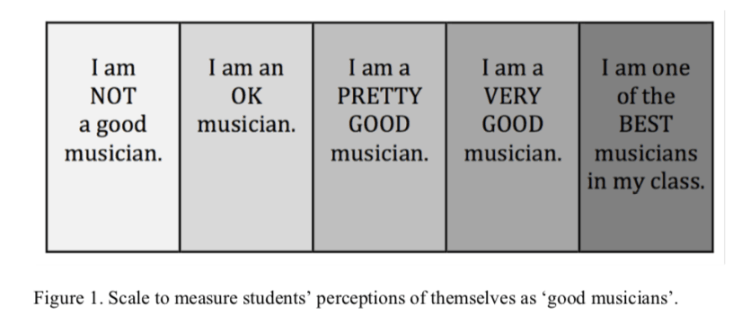
Shouldice (2014) individually interviewed 347 students in grades one through four.  The students answered questions pertaining to the kinds of things a good musician can do, how one knows if a person is a good musician, and who can be a good musician. At the conclusion of each interview, each student was asked to choose the statement that best described him/herself (see scale in Figure 1) and explain why.

What did the researcher find?

While students across all grade levels most commonly described a “good musician” as someone who plays an instrument, practices, and/or sings well, other characteristics fluctuated across grade levels, suggesting that students’ perceptions of what it means to be a “good musician” may change over time in relation to their own experiences.  Statistical analysis showed that students in grade one perceived themselves as better musicians than did students in upper grade levels, indicating that elementary students’ perceptions of their own musical ability may diminish as they get older.

Qualitative analysis of the data revealed that some children’s ability self-perceptions were based on how they believed others perceived their abilities, such as a first-grade girl who knew she was a good musician “because my [music] teacher always picks me first” (p. 336), or were reached as a result of comparing themselves to others.  A number of students believed that innate musical talent is necessary in order for a person to be a “good musician;” their comments included the belief that “only some people are born with the talent” and “either you got it or you don’t” (p. 339).  Additionally, responses from some students implied the belief that skill in certain musical genres or modes of music making do not qualify one as a “good musician,” such as one second-grade boy’s statement that rappers and beat-boxers cannot be good musicians and that he himself was not a good musician despite describing himself as a “rapping pro.”

What does this mean for my classroom?

Elementary music teachers should be aware of the tendency for students’ musical ability self-perceptions to diminish over time and work to help students maintain positive musical identities as they get older.  Teachers also should be aware of the ways in which they might inadvertently communicate their own judgments of students’ musical abilities and/or beliefs about the value of certain musical genres or modes of musicking.  Additionally, teachers can encourage students to focus on effort and practice as determinants of musical ability rather than emphasizing innate musical talent.  

Note: Text featured in this post was originally published in the following article:

Shouldice, H. N. (2016). Research to ‘real life’: Implications of recent research for elementary general music. Michigan Music Educator, 53(2), 23-26.

RTRL.01:“The Effects of Harmonic Accompaniment on the Tonal Improvisations of Students in First Through Sixth Grade” (Guilbault, 2009)

Source:

Guilbault, D. M. (2009). The effects of harmonic accompaniment on the tonal improvisations of students in first through sixth grade. Journal of Research in Music Education, 57(2), 81-91.

What did the researcher want to know?

How might experiencing root melody (bassline) accompaniment to songs affect elementary students’ tonal improvisations?

What did the researcher do?

Guilbault (2009) studied 419 of her own students in grades one through six for almost an entire school year.  These students were divided into two groups, with approximately half of the classes (the “treatment” group) experiencing “root melody” accompaniments during music instruction and the other half (the “control” group) experiencing only a cappella singing.  Similar to a bassline, “a root melody is the melodic line created by the fundamental pitches of the harmonic functions found in a song” (p. 84).  Pitches in a root melody can be played/sung and sustained once per chord change or repeated on each beat.  The students in the treatment group experienced root melodies with approximately 80% of the songs included in each class period and during improvisation activities.  These root melody accompaniments were either played on a pitched instrument (e.g., xylophone, piano), played by a voice recording, sung by the teacher/researcher as the students sang a song, sung by the students as the teacher/researcher sang a song, or sung by the student(s) as another student(s) sang a song.  The students in the control group experienced all the same songs and improvisation activities as the treatment group but without any accompaniment.

What did the researcher find?

At the end of the school year, Guilbault (2009) recorded each student vocally improvising an ending to an unfamiliar song without accompaniment. Three music educators judged the recordings, rating the degree to which each student improvised a melodic ending that used clearly implied harmonic changes and good harmonic rhythm. Statistical analysis of these ratings revealed that the students in the treatment group (who had experienced root melody accompaniments throughout the school year) were able to vocally improvise song endings that made more harmonic sense than students in the control group (who had not experienced root melody accompaniments).

What does this mean for my classroom?

Exposing students to harmonic progressions in familiar songs helps them develop better harmonic understanding, which in turn enables students to vocally improvise with a better sense of harmonic progression. If music teachers wish to help their students develop the ability to vocally improvise with a good sense of harmonic progression, they might consider providing students with many opportunities to experience root melody accompaniments to the songs they learn in music class. Teachers could do this by playing root melody accompaniments on an instrument, singing them while students sing a song, teaching students to sing root melody accompaniments while the teacher sings the song, or having students sing songs and root melody accompaniments in two groups or even as duets.

Examples of Tunes with Simple Chord Root Accompaniments:

Video of first grade students practicing singing a melody and bassline/chord root accompaniment in partners. (View video description on YouTube site for an overview of the teaching process used.)
Video of first grade students singing a duet with me: I sing melody; student sings chord roots in solo. (View video description on YouTube site for an overview of the teaching process used.)

Note: Some text featured in this post was originally published in the following article:

Shouldice, H. N. (2016). Research to ‘real life’: Implications of recent research for elementary general music. Michigan Music Educator, 53(2), 23-26.

Why “Research to Real Life”?

That research stuff only matters in the “ivory tower” and has nothing to do with real music teachers, right? Wrong! This blog will share findings of recent research studies that are relevant for music educators and can inform our teaching practice. Instead of focusing on jargon and statistics, we will look at how these research findings can be applied in practical ways to improve the experiences we provide our students.

“Rather than assuming we know what is effective or doing something because ‘that’s how we’ve always done it,’ music teachers can advance their teaching practice in an evidence-based way by reading current music education research” (Shouldice, 2016, p. 25).


Shouldice, H. N. (2016). Research to ‘real life’: Implications of recent research for elementary general music. Michigan Music Educator, 53(2), 23-26.